In what ways does the history of Australia’s north (e.g. Queensland)
challenge conventional narratives of Australian history?
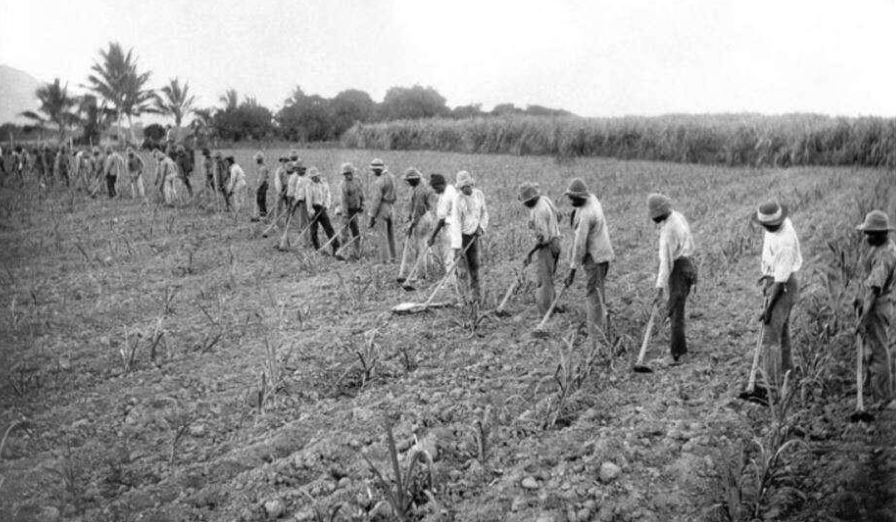
Communal memory is selective and has serious implications for those whose history is deemed worth remembering and for those whose history is forgotten. Australian history tends to “smother moral consciousness” in order to produce a narrative that is “unblemished”. Narratives of the north are driven by humane, white-colonial success. However, the 1970s and early 1980s sparked a “renaissance of interest” on post-colonial discourse in conventional elite historiography. Academic and media attention has brought focus to the beginnings of Australia’s sugar industry and the narratives it has hidden. During the mid-19th century, against a backdrop of colonialism, the Queensland sugar industry underwent a shortage of labour, resulting in the recruitment of over 62,000 [4] so-called ‘Kanakas’ or South Sea Islanders (SSI) from the South Pacific such as Vanuatu, the Solomon Islands, New Caledonia, and Fiji. The SSI were lured or forcibly brought over by boat to work as “indentured labourers”[5], enslaved in Queensland’s sugar plantations, and quickly made up the brunt of the workforce. The industry quickly ruffled feathers for many, as the threat of multiethnicity loomed over a so-called ‘White Australia’. The SSI trade made significant impacts within our history, yet is typically lost in our conventional narratives of the North. According to Mark McKenna, we have long held an anxiety that yearned for the need to create a foundational historical or origin myth. This has manifested as a narrative of colonial pioneers who battled the northern terrain to achieve economic success. However, the inclusion of SSI voices directly disrupts our curated origin understandings. Further, despite historians and SSI’s alike conveying the horrors of the trade, the need for a neat history is still maintained by politicians and certain historians. Rather, Australia’s past of slavery has been supplanted by neat versions of the past that glorify domination, telling a history that has been rendered incomplete. Finally, our narratives of a predominantly white populated society until the later 20th century immigration is challenged through the analysis of the White Australia policies and its attempt to remove any blemish to racial discrimination. Thus, revising our narratives shows the complexity of the past and refrains from reducing history to a shallow field of point scoring.
Pioneers or Profiteers?
The narrative of Northern success built on pioneers and entrepreneurs who toiled its lands is underpinned by the labour of non-Europeans, including the SSI peoples. Australian wealth rode on the success of the sugar industry, an “economically viable” production that boomed in the “agriculturally appropriate” climate of Queensland. The “dense tropical vegetation” made the harvesting of sugarcane a physically demanding job, as was one that Europeans considered themselves unsuitable for. The north’s “ferocious tropical climate” created a “lack of manpower” which, created a stigma that field labour was socially beneath them. These assumptions influenced the nature of the societies that developed in the north and led to a shortage of labour within the Sugar industry, resulting in indentured recruitment from the South Pacific. Many Indentured labourers signed a contract to work for a specific master for a specific period of time in exchange for a set payment (or to pay off a debt). Many were only paid a total of “six pounds per year”, falling well below what Europeans were entitled to.
Much of the success that led to the boom was due to the cheap, compliant labour obtained through SSI indenturing. As Clive Moore points out, the early labourers are to be credited for the “land clearance, wharves, roads and bridges” which facilitated the expansion of Queensland's sugar wealth. This cheap and profitable usage of indentured labour thus increased sugar production from “168 tons to 19,051 tons”(uow) within the years 1867 to 1881. While the entrepreneurs, plantation owners and shareholders thrived on the sugar cane boom, it is commonly forgotten that this success largely rested on the “broad backs of the many Pacific Islanders” who provided this “necessary labour”. Irvine focuses on the accounting of SSI and their responsibility for the “remarkable growth” of CSR. Irvine highlights how the company “sustained success in the sugar industry” through the low costs of indentured labour, thereby “increasing profits”. Their successful dependence on the labour of the SSI became obvious as a cessation of SSI labour saw a dramatic plummet in “maintaining a profitable operation”.
The glorification of “colonial princes” who pioneered through the north’s terrain is typical of founding myths promulgated by early twentieth-century academic historians, manipulating public history to promote myths of white superiority and celebrate colonialism, denying contemporary effects of racism in post-colonial Australia. This is ‘history from above’, in which history is controlled by a dominant class, silencing the experiences of the marginalised and promoting flattering depictions of itself.
“There was no slavery in Australia” – Scott Morrison
Since the British invasion, there has been a dominant perception of Australian pride in having a national past that is “patriotic, tidy and usable”[15]. The Pacific Islanders were subject to exploitative mistreatment akin to the conditions of slavery; however, they have not been recognised by subsequent Australian governments, as it contradicts their curated narrative of Australia’s north. The term ‘revisionism’ has become a “word of opprobrium,”[12] an adjective used to condemn opposing perspectives attaching negative connotations to nuanced narratives. This is evident when the chosen history conflicts with commonly held beliefs, such as Australia’s accounts of slavery, or lack thereof.
The British Empire had already ended slavery in 1807, following the Act for the Abolition of the Slave Trade, which made any form of slavery illegal. However, although SSi were recognised and labelled as doing “indentured labour”[30], this legal definition does not mean the men didn’t experience slave-like conditions”31. When a population is brought into a “white… civilised” country for the “mere purposes of labour” there is no doubt they will “inevitably fall into the position of slaves”. Historian Clive Moore has written extensively on SSI, synthesising the “most cruel treatment” endured, revealing Many labourers died of neglectful and cruel deaths which “was often horrific” (Moore, 2017), seeing most overworked before finishing their contracts. Government records show that more than 14,564 or 30% (conciliation colonial article) of all labourers involved died in Queensland, making it the highest death rate for any group of immigrants in Australia today.[29] This number is expected to grow as mass graves are still being uncovered today (https://www.abc.net.au/news/2016-06-07/discovering-umarked-australian-south-sea-islander-graves/7484830 ). These conditions have not just been brought into light following the end of the trade as historians begin to revise our curated narratives. The sourcing of SSI during its peak, “had for some time been under investigation”. The 1869 case of ‘Daphne’, a seized shipment of labourers bound for the fields of Queensland, made a case for those found “kept and detained in slavery” (https://trove.nla.gov.au/newspaper/article/18740107). The case offered an officer’s description of a female SSI, describing finding her as someone “fitted up like an African slaver, minus the irons... they were stark naked; not even a mat to lie upon” (Water Police Court, 1871).
Yet, there are still fierce defenders of the traditional narratives of the north. Windschuttle critiques many perspectives offered by historians wishing to “paint the trade in unsavoury terms”. Windschuttle notes that every scholarly historian who has examined the primary source evidence has concluded that the “great majority of these labourers left their homes willingly,” overall fabricating a history of slavery that does not exist. Windschuttle blames the “overtly leftist” mentality perpetuated in the media and school curriculum, feeding the narrative of kidnapping and slavery. However, as criticised by Barker and Byford, while Islanders were claimed to have arrived “voluntarily” (uow) it was uncertain whether SSI actually understood the contracts they signed. If the narrative changes to agree and reckon with forcibly indentured workers then puts the narrative of “no slavery” under great scrutiny.
Historical censorship is rife in colonial history, and we can see this epitomised as the slave trade hasn’t been remembered for its horrors but rather has been memorialised. Benjamin Boyd arrived in Australia as a Scottish immigrant in 1842. He left behind a legacy of economic success following his development of a “pastoral empire(54), remembered through memorials littered across NSW. In his lifetime, Boyd was simultaneously criticised and commended for his economic engagements, and was condemned for his use of forced labourers in a supposedly post-slavery society. However, Boyd’s connections to the trade have been less well remembered than his “colourful life”55. Historian Mark Dunn revealed Boyd’s slave business was never mentioned in known documentation and was downplayed within his brother's memoir. His memorialisation appears to seek some “tangible reminder… of past triumph and departed heroes” 19). Memorials of this era exhibit a “pioneer mythology” 20 exemplified in a pair of commemorative tablets erected in Neutral Bay by the Royal Australian Historical Society (RHAS) in 1931. In 2021, the North Sydney Council endorsed the inclusion of a third interpretive plaque. Hoskins’ suggested text for this counter-monument does not make judgments on the 1931 inscriptions, but provides the public with a holistic representation of Boyd, enabling independent critical analysis. The inscription includes that Boyd “pioneered the coercive or duplicitous recruitment of labour from the Pacific islands known as ‘blackbirding’.” The social meaning of monuments is always in flux and even contradictory, because the world in which monuments exist is never fixed, even if the monuments themselves are. As the slavery debates grow, it has society reevaluating what we deem worthy of memorialisation, specifically the importance of memory and what we deem problematic in history.
Narratives of Whiteness
Approaching Australian histories with a different geographical perspective can change our assumptions about founding stories. Narratives of the north are closely connected to that notion of expansive population that takes place from the 19th into the 20th century, with this growth particularly evident in Queensland. Starting in the 1860s, 62,000 Pacific Islanders from 80 different islands worked in the Australian sugar industry, making up 85% of the workforce (FIND SOURCE). Thus, the north had become a fairly heterogeneous place, but within the 1890s saw pressure on labour and a new national foundation built on hardcore racial stratification. Multiethnicity and the reliance on non-European labour concerned many people in the southern states, raising arguments about working conditions for white men and safeguarding Australia’s Britishness. Thus, as the 20th century arrived, a series of race-exclusive immigration restrictions began to protect the narrative of white domination despite having formed significant communities of SSI. The trade union movement perceived the exploitative use of the SSI as a threat, as it seemed to “undermine the working conditions of the white population” (uow). The trade union movement felt threatened by the abusive employment of the SSI since they appeared to undermine the working conditions of the white population (Brändle, 2001, p. 37) (uow). The trade, however, “continued unabated” (Mark Dunn) until the 1901 Federation of Australia. This brought in a new wave of racism, triggering the White Australia policies designed to keep Australia’s population ethnically, culturally, and linguistically homogenous within a suite of acts and measures. Under the banner of these policies was the Immigration Restriction Act 1901, which brought the trade to an end. The Pacific Islander Labourers Act (1901) further aided the expulsion of non-Europeans from Australia, deporting nearly 10,000 workers. However, as suggested by historian Mark Dunn, this was not introduced with a “humanitarian impulse” but rather was “more to do with race”. Only 700 SSI remained in the colony by 1907 (SOURCE) following protests, which allowed “long-term residents” to remain in Australia, continuing a generation that still lives on these lands today. This “symbolic act of expulsion” fed into a narrative of a white-only Australia, a white narrative that is being maintained today as many Australians continue to “deny the islanders any ancestry status” as they “fall through the cracks” of Australian society. SSI descendant, Faith Bandler, lives in Australia and is living “defiance of White Australia”; her “very existence” is a symbol of protest against an origin myth of whiteness. Thus, this is demonstrative in how the writing of our national identity is both partial and driven as a powerful political act, creating importance in recognising what is being purposefully left out.
Conclusion
Thus, attempting to reduce the past into neat uplifting stories of patriotism, erase the past’s horrors and renders those affected voiceless. It is a powerful silencing tool “to serve nationalist and imperialist agendas,” excluding the histories of South Pacific Islanders as peripheral. It is imperative to rewrite our national narratives to include these so-called “hidden histories” to gain a full understanding of our national identity.